How Do You Find Housing in the Netherlands on a DAFT Visa?
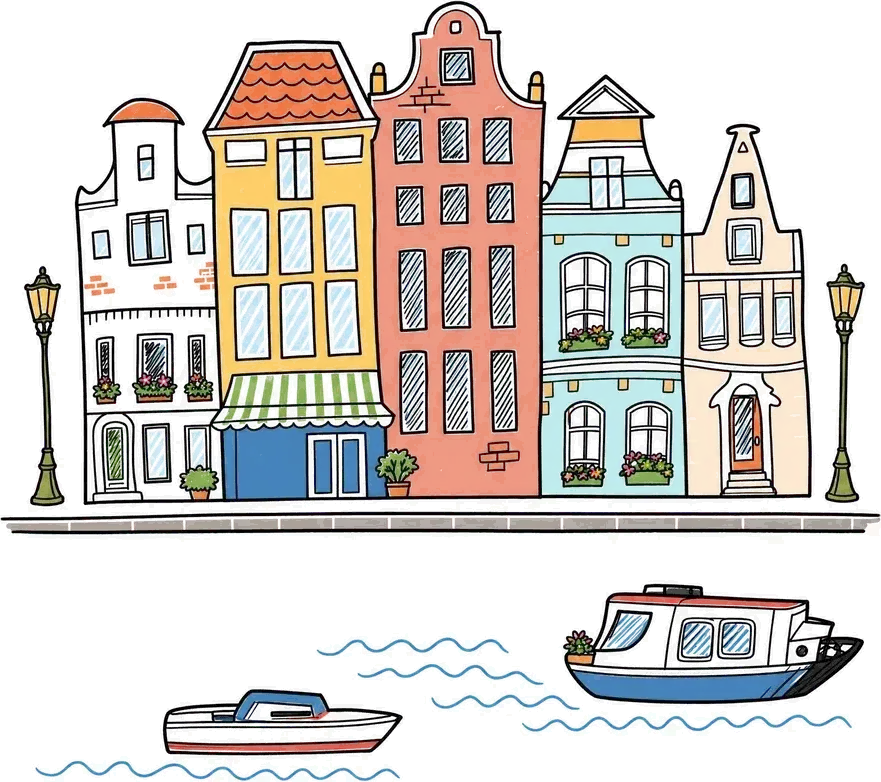
The Netherlands is short approximately 410,000 homes as of early 2026, and the average housing search for expats takes 3–6 months. DAFT visa applicants face additional friction because they lack Dutch payslips and rental history. Expect to pay €1,200–2,200/month for a one-bedroom depending on the city, with Amsterdam requiring 6–12 months' rent upfront as deposit. Start searching remotely 3–4 months before arrival and consider cities outside Amsterdam — Eindhoven and Groningen offer significantly better availability.
→ Check which visas you qualify for with our free income calculator
Getting approved for the DAFT visa is the easy part. The approval rate for properly prepared American applicants is close to 100%. The IND reviews your paperwork, checks the €4,500 deposit, and issues your residence permit — typically within four to six weeks.
Finding somewhere to live is where people fail. If you haven't already, start with our complete DAFT visa guide for the full application process, costs, and timeline.
Housing is the number one reason DAFT applicants abandon the process after approval or regret their move within the first year. And most of the cheerful "just move to Amsterdam!" guides on the internet skip over this entirely, or mention it as a footnote. It's not a footnote. It's the entire ballgame.
How Bad Is the Dutch Housing Shortage?
The Netherlands is short approximately 410,000 homes as of early 2026, according to research by Capital Value and ABF Research. That's 4.8% of the total housing stock — nearly double the government's 2.1% target. The shortfall has been growing, not shrinking, despite official targets of building 100,000 new homes per year. Actual completions in 2025 came in around 69,200.
The rental market has been hit hardest. The Affordable Rent Act (Wet betaalbare huur), introduced in July 2024, expanded rent controls to cover more of the housing market by raising the points threshold for regulated housing. The intention was to protect tenants. The effect has been a mass exodus of landlords — over 26,000 rental homes were sold to owner-occupiers in the past year, and international investors have been reducing their Dutch portfolios. Available rental supply in Amsterdam has dropped from roughly 7,000 properties per quarter before the reform to around 2,500.
Free-sector rental listings across the Netherlands now stay online for an average of just 18 days. In Amsterdam, desirable apartments are gone within 24 to 48 hours.
Why Is Housing Harder for DAFT Applicants?
Regular expats arriving with a corporate relocation package and a Dutch employer's backing already struggle. DAFT applicants face additional friction because of how the visa is structured.
No Dutch employer, no Dutch payslips. Landlords typically require proof of income at three to four times the monthly rent. A DAFT holder running a freelance business (ZZP) or a freshly registered sole proprietorship has no Dutch income history. You can show US bank statements and client contracts, but many landlords simply move on to the next applicant who has a Dutch employment contract.
The chicken-and-egg problem. You need a registered address in the Netherlands to get your BSN (citizen service number) from the municipality. You need a BSN to open a Dutch business bank account. You need the business bank account to register with the KvK (Chamber of Commerce) and deposit the €4,500. But many landlords want to see a BSN and KvK registration before they'll rent to you. Every step in the DAFT process feeds into the next, and housing is the bottleneck that everything else depends on.
No tenant protections in temporary housing. If you end up in temporary arrangements while you sort out permanent housing — hotel, Airbnb, short-stay apartment — you can sometimes register at those addresses for BSN purposes, but many municipalities won't accept them for permanent registration. And without permanent registration, the rest of your DAFT timeline stalls.
What Does Housing Cost in Dutch Cities?
Forget the optimistic numbers you see on some expat blogs. Here's what DAFT applicants are realistically looking at in 2026, based on free-sector rental prices for the kind of apartments most American families would consider livable.
Amsterdam: A one-bedroom apartment in the center averages around €2,200 per month. A two- or three-bedroom family apartment runs €3,500–€4,500. Landlords require gross income of three to four times the rent, meaning you'd need to demonstrate €6,600–€13,500 per month to qualify. And you'll likely need to show six to twelve months of rent upfront as a deposit or guarantee, because you have no Dutch credit history.
Rotterdam: More affordable at roughly €1,600 per month for a one-bedroom in the center. Still competitive, but the supply situation is somewhat less dire than Amsterdam. The city's tech and creative sectors mean landlords are slightly more accustomed to non-traditional tenants.
The Hague: Similar to Rotterdam at around €1,500 per month for a one-bedroom. Home to many international organizations, so landlords in certain neighborhoods have experience renting to expats without Dutch employment contracts.
Utrecht: Increasingly expensive, with one-bedroom rents approaching €1,400–€1,600 in the center. The student population creates intense competition for smaller units.
Eindhoven: The sleeper pick. One-bedroom rents average €1,200–€1,400. The tech ecosystem (ASML, Philips, the Brainport cluster) means a significant international community, and landlords in neighborhoods like Strijp-S are accustomed to expat tenants. Less glamorous than Amsterdam, but significantly more feasible for DAFT applicants.
Groningen: The most affordable major city in the Netherlands, with one-bedroom rents starting around €900–€1,100. Excellent quality of life, vibrant university city, far from the Randstad housing pressure. If you work remotely and don't need to be in the western Netherlands, Groningen deserves serious consideration.
How Much Money Do You Actually Need to Land in the Netherlands?
Here's where most DAFT guides fail you. They mention the €4,500 IND deposit and move on. The actual capital you need to land in the Netherlands and survive the first three months looks very different.
IND fees: €423 per applicant, plus €254 for a spouse and €85 per child.
Business setup: KvK registration (€85.15), accountant for opening balance sheet (€500), Wise Business or Dutch bank account setup (€50).
Housing deposit: Six to twelve months upfront rent is common for applicants without Dutch income history. For a €1,800/month apartment, that's €10,800–€21,600 before you've slept a single night.
Temporary housing while searching: Budget four to eight weeks in a short-stay apartment or Airbnb. In Amsterdam, that's €2,000–€4,000 per month. In smaller cities, €1,200–€2,000.
Health insurance: Mandatory once you're registered. Basic Dutch health insurance runs approximately €130–€160 per month, with additional coverage bringing it higher. Until you have a BSN, you may need temporary expat insurance (Feather, for example, offers policies starting around €72/month for the transition period).
Living expenses: Food, transport, phone, and incidentals for the first three months while you have no Dutch income flowing.
One immigration firm that specializes in DAFT applications, NordicHQ, recommends a total liquidity buffer of €100,000 for a comfortable family landing. That sounds extreme, but when you add up housing deposits, temporary accommodation, business setup costs, IND fees, health insurance, and three months of living expenses for a family of four — the math gets there fast.
A more realistic minimum for a single applicant: €15,000–€20,000 beyond the €4,500 IND deposit. For a family: €25,000–€40,000. You can do it for less if you're willing to take risks, land in a cheaper city, and move fast. But going in undercapitalized is the most common reason people burn through their savings and retreat to the US within six months.
What Is Anti-Kraak and Should DAFT Applicants Consider It?
One housing strategy that shows up in DAFT communities is anti-kraak — literally "anti-squat." Property owners with temporarily vacant buildings (offices, schools, former care homes) hire agencies to place residents in them as guardians, preventing illegal squatting and vandalism. In exchange, you get housing at dramatically reduced rates: typically €80–€350 per month.
It sounds ideal. Cheap rent in one of Europe's most expensive housing markets. But there are significant trade-offs that matter for DAFT applicants specifically.
Limited tenant protections. Anti-kraak residents are classified as "users," not tenants. You sign a usage agreement, not a lease. The agency can enter the property without notice and typically retains a key. The standard rental protections under Dutch law don't apply.
Short notice periods. You can be asked to leave with as little as 28 days' notice. The building owner decides when to develop, sell, or repurpose the property, and your usage agreement ends when they do. This creates instability that's stressful for anyone, and potentially disruptive to a DAFT application timeline.
Children are often prohibited. Many anti-kraak agreements explicitly prohibit children from living in the property. If a resident becomes pregnant, the agency may terminate the agreement. For DAFT families, this is usually a disqualifier.
Registration varies. Some anti-kraak addresses can be used for municipal registration (which you need for your BSN), but not all. Confirm this before signing anything — without a registered address, your entire DAFT process stalls.
Anti-kraak can work as a deliberate, short-term landing strategy for solo applicants who plan to move into permanent housing within a few months. It buys time cheaply while you sort out BSN, KvK, and bank account sequencing. But it's not a housing solution — it's a temporary bridge.
Major anti-kraak agencies include Camelot, Ad Hoc, and Villex. Waiting lists exist, and competition for the better properties (actual apartments rather than converted offices) is fierce.
Which Dutch Cities Are Most Feasible for DAFT Applicants?
Let's be honest about geography. If your mental image of moving to the Netherlands is a canal-side apartment in Amsterdam's Jordaan neighborhood, you need to recalibrate your expectations unless your budget is exceptional.
The cities where DAFT applicants realistically land and stay are often not Amsterdam. The Netherlands is a small country with excellent infrastructure — you can get from Eindhoven to Amsterdam by train in 75 minutes. The quality of life difference between Dutch cities is measured in vibes, not fundamentals.
Eindhoven has the strongest case for DAFT applicants. Lower rents, a large international tech community, landlords accustomed to expats, and a growing startup ecosystem. Neighborhoods like Strijp-S (a converted Philips factory campus) have become hubs for creative and tech professionals. Sixty percent of all international tenant activity in the Netherlands is concentrated in Amsterdam and The Hague — meaning Eindhoven has genuine room.
Utrecht splits the difference between Amsterdam prices and Amsterdam energy, with better housing availability. It's the fastest-growing city in the Netherlands and increasingly attractive to young professionals.
Groningen and Tilburg offer the most affordable options with legitimate urban infrastructure. Groningen in particular has a university-driven energy that makes it feel much larger than its population suggests, and rents that are roughly half of Amsterdam's. If the housing situation makes you reconsider the Netherlands entirely, our comparison of Spain, Portugal, and the Netherlands can help you weigh the tradeoffs. For Americans, the same budget that barely gets you a studio in Amsterdam can rent a two-bedroom in Valencia — see our guide to the best cities in Spain for the comparison.
The Hague works well for DAFT applicants whose businesses serve international organizations or government-adjacent sectors. The international community is established and landlords in neighborhoods like Statenkwartier and Benoordenhout expect expat tenants.
Where Do You Search for Dutch Rental Housing?
The platforms Americans typically discover first aren't necessarily the best ones for DAFT applicants.
Funda (funda.nl) is the dominant Dutch property portal, but it skews toward sales and regulated-sector rentals. Useful for understanding the market, less useful for finding free-sector rentals quickly.
Pararius (pararius.nl) is the go-to for free-sector rental listings, with full English-language support. This is where most DAFT applicants will do their primary searching. Listings move fast — check daily and respond within hours, not days.
Kamernet (kamernet.nl) covers room rentals and shared housing. More relevant for solo applicants than families.
Facebook groups are surprisingly active. "Housing in Amsterdam," "Expats in Rotterdam," and city-specific groups regularly post listings — including private landlords who don't list on formal platforms. The signal-to-noise ratio is low, but these groups surface opportunities you won't find elsewhere.
Rental agents (makelaars) can be worth the cost for DAFT applicants who need someone to navigate the market on their behalf. Agents charge one month's rent as a fee, but they have access to off-market listings and understand which landlords will accept non-traditional income documentation. For a family relocating from the US with limited time to apartment-hunt in person, this investment often pays for itself.
How Do You Avoid Rental Scams in the Netherlands?
The housing shortage has created a thriving scam ecosystem targeting international tenants. Every year, thousands of expats lose deposits to fraudulent listings. Protect yourself with these rules.
Never transfer money before viewing a property in person. This is the single most important rule. No exceptions — not for "holding deposits," not because "someone else is interested," not because the landlord "lives abroad."
Never pay via WhatsApp or informal channels. Legitimate landlords and agencies use bank transfers with proper documentation. If someone asks for payment through Western Union, cryptocurrency, or gift cards, it's a scam.
Verify the address through Kadaster. The Dutch land registry (kadaster.nl) lets you look up property ownership for €3.70. Before signing anything, confirm that the person claiming to rent you the apartment actually owns it or has authority to lease it.
Beware of listings significantly below market price. If a beautiful canal apartment is listed at €900/month when everything comparable is €2,000, it's bait. Housing scammers know exactly what prices will attract desperate searchers.
Ask if you can register at the address. If the answer is no, walk away. It could be an illegal sublet, and you could face eviction with no recourse — plus you won't be able to get your BSN, which torpedoes your entire DAFT process.
What Does a Realistic DAFT Housing Timeline Look Like?
Here's what a realistic DAFT landing looks like when housing is factored in properly.
Before departure (from the US): Begin remote apartment searching three to four months before your planned arrival. Reach out to rental agents in your target city. Join Facebook groups. Set up Pararius alerts. Understand that you probably won't secure permanent housing before arrival — but you can shortlist neighborhoods, understand pricing, and line up viewings for your first week.
Weeks 1–2 in the Netherlands: Arrive in temporary housing (short-stay apartment, Airbnb, hotel). Attend your IND appointment — you'll receive a passport sticker confirming your application is pending, which lets you stay beyond the tourist 90-day limit. Start viewing apartments immediately. Move fast on anything acceptable.
Weeks 2–4: If you've secured housing, register at the municipality (Gemeente) to get your BSN. If not, continue searching. This is the anxious period — you're burning through temporary housing budget while the bureaucratic clock ticks.
Weeks 4–8: With BSN in hand, open a Dutch business bank account, deposit the €4,500, register at the KvK, and get your accountant to prepare the opening balance sheet. Sign up for Dutch health insurance. The DAFT sequencing can now proceed.
Months 2–3: IND processes your application and issues the verdict. During this period, you're legally present (the passport sticker covers you) and building your Dutch life — setting up DigiD, getting a phone plan, learning where to buy normal groceries.
The average housing search for expats in the Netherlands takes three to six months. Factor that into your financial runway.
The Bottom Line
The DAFT is one of the most accessible visa pathways to Europe. The €4,500 investment threshold is remarkably low compared to other countries. The approval process is straightforward. The Netherlands itself — infrastructure, English proficiency, central European location, quality of life — is genuinely exceptional.
But the housing market is the hidden filter. It doesn't show up in your eligibility assessment. It doesn't appear on the IND website. It only becomes real when you land and start competing for apartments against Dutch professionals with employment contracts, credit histories, and local networks.
Go in with realistic expectations, sufficient capital, flexibility on which city you'll live in, and a timeline that accounts for the search. The DAFT works. Housing is the part you have to solve yourself.
Ready to prepare your documents? Our platform generates your complete visa application package — pre-filled forms, cover letters, and a step-by-step checklist. Start your free assessment →
Frequently Asked Questions
How long does it take to find housing in the Netherlands as a DAFT applicant?
The average housing search for expats takes 3–6 months. DAFT applicants often face longer searches because they lack Dutch payslips and credit history. Start searching remotely 3–4 months before arrival and budget for 4–8 weeks of temporary housing.
How much money do you need beyond the €4,500 DAFT deposit?
A realistic minimum for a single applicant is €15,000–€20,000 beyond the €4,500 IND deposit. For a family, budget €25,000–€40,000. This covers housing deposits (6–12 months upfront is common), temporary accommodation, business setup, IND fees, health insurance, and 3 months of living expenses.
Can you register at a temporary address for your BSN?
It depends on the municipality. Some accept short-stay apartments or Airbnb addresses for BSN registration, but many do not accept them for permanent registration. Always confirm with the specific gemeente before signing a temporary housing agreement — without registration, your DAFT process stalls.
Is Amsterdam realistic for DAFT applicants?
Amsterdam is possible but challenging. One-bedroom apartments average €2,200/month, landlords require 3–4x rent in income proof, and 6–12 months' rent upfront as deposit. Cities like Eindhoven (€1,200–1,400/month), Rotterdam (€1,600), and Groningen (€900–1,100) offer significantly better feasibility for DAFT applicants.
What is anti-kraak housing and is it good for DAFT applicants?
Anti-kraak ("anti-squat") places residents as property guardians in vacant buildings for €80–350/month. It can work as a short-term bridge for solo applicants, but has major drawbacks: 28-day eviction notice, no tenant protections, children often prohibited, and not all addresses allow municipal registration. It's a temporary strategy, not a housing solution.
How do you prove income to Dutch landlords without a Dutch employer?
Show US bank statements, client contracts, and proof of business registration. Some landlords will accept a larger upfront deposit (6–12 months) in lieu of Dutch income proof. Working with a rental agent (makelaar) who understands non-traditional income documentation can significantly improve your chances.
Not sure if the Netherlands is the right fit? Our free eligibility assessment compares DAFT with Spain and Portugal in about 5 minutes.
Our DAFT wizard walks you through every step of the visa process including housing timing and the BSN-KvK-bank sequencing — but the apartment hunt is yours to navigate. Here's how to show up prepared.
Sources: Capital Value / ABF Research housing shortage report (Feb 2026), NL Times, Dutch Central Bank (DNB), RentHunter, Expatica Netherlands cost of living 2026, IAmExpat, Pararius, Investropa Netherlands rents report (Jan 2026). Rental prices based on free-sector listings across multiple platforms as of February 2026. IND fees and DAFT requirements current as of 2026.